Option Greeks and Black-Scholes calculator
Free Black-Scholes option calculator for Nifty, Bank Nifty and stock options: fair price, delta, gamma, theta, vega and rho, and implied volatility from the market price.
The option
Choose an underlying to fill in its last price, at-the-money IV and days to the nearest expiry from our option chain data.
Black-Scholes price and Greeks
- Call price
- —
- Put price
- —
- Call delta
- —
- Put delta
- —
| Greek | What it measures | Call | Put | Call, one lot | Put, one lot |
|---|
Implied volatility from a market price
How the Black-Scholes model prices an option
The Black-Scholes model gives the fair price of a European option, one that can be exercised only at expiry, from the price of the underlying (S), the strike (K), the time to expiry in years (T), the interest rate (r) and the volatility (σ). Index options on NSE and BSE and NSE stock options are European, so it is the standard model for them. With a dividend yield q:
d1 = (ln(S ÷ K) + (r − q + σ² ÷ 2) × T) ÷ (σ × √T), and d2 = d1 − σ × √T
Call = S × e−qT × N(d1) − K × e−rT × N(d2), and Put = K × e−rT × N(−d2) − S × e−qT × N(−d1), where N is the standard normal distribution. The calculator counts calendar days to expiry over 365.
What the Greeks tell you
- Delta: the change in the option's price for a ₹1 rise in the underlying. A call's delta runs from 0 to 1 and a put's from 0 to −1; at the money it is near ±0.5. Delta × lot size is how many units of the underlying one lot behaves like.
- Gamma: how much delta changes for a ₹1 move. It is highest at the money near expiry, which is why short-dated options' prices jump around.
- Theta: the price lost in one day with nothing else changing, the time decay that option sellers collect and buyers pay.
- Vega: the price change for a one-point change in implied volatility, say from 12% to 13%.
- Rho: the change for a one-point change in interest rates; small for weekly and monthly options.
Implied volatility
Every input except volatility can be seen. Implied volatility (IV) is the volatility that makes the model's price equal the market premium, so it is the market's price for uncertainty. The calculator finds it by trying volatilities until the price matches. Comparing an option's IV with its own history, or with other strikes, shows whether it is expensive or cheap relative to them; read more in what implied volatility is and option Greeks explained.
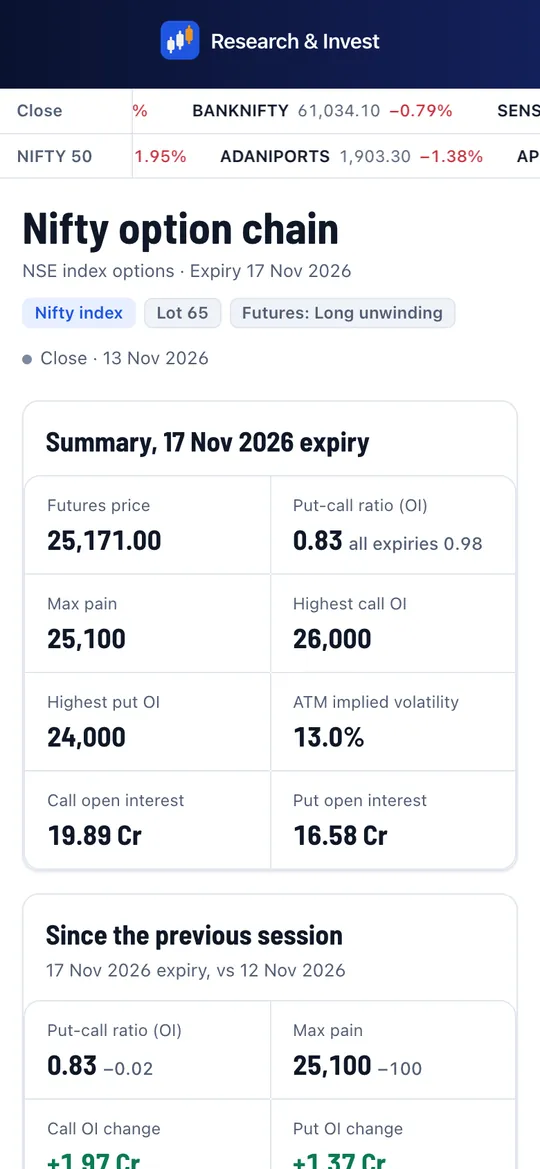
Why other sites show different Greeks: they may use the futures price instead of spot, a different interest rate, trading days instead of calendar days, or each strike's own IV. Same inputs, same answer. The live IVs and Greeks for every strike are on the Nifty option chain.
Frequently asked questions
What is the Black-Scholes model?
A formula for the fair price of a European option from five inputs: the price of the underlying, the strike, the time to expiry, the interest rate and the volatility. Nifty, Bank Nifty and NSE stock options are European (exercised only at expiry), so it is the usual model for them.
What do delta, gamma, theta and vega mean?
Delta is how much the option's price moves for a ₹1 move in the underlying. Gamma is how much delta changes for that ₹1 move. Theta is the price lost per day as expiry nears, all else equal. Vega is the price change for a one-point change in volatility. Rho is the change for a one-point change in the interest rate.
What is implied volatility (IV)?
The volatility that makes the Black-Scholes price equal to the option's market price. Enter the market premium and the calculator solves for it. A higher IV means the market is paying more for the option.
Why do Greeks differ between websites?
Each site uses its own inputs: spot or futures price, the interest rate, the day count to expiry and the IV of each strike. With the same inputs, the Black-Scholes numbers are the same everywhere.
Which interest rate should I use?
Traders usually take a short-term government rate such as the 91-day Treasury bill yield. Option prices change little with it for near expiries.
Test it in the Strategy Lab. Build the trade on live option prices, see its payoff, Greeks and Trade Check score, and how the same setup did on past expiries after costs.
Start free trialFor education only; not investment advice or a recommendation to buy, sell or trade. A SEBI study (FY22–FY24) found that about 9 in 10 individual F&O traders made net losses.